Download a printable PDF version of this reading guide for use in your book club or reading group.
The suggested questions are intended to help your reading group find new and interesting angles and topics for your discussion of The God of War. We hope that these ideas will enrich your conversation and increase your enjoyment of the book. Many fine books from Simon & Schuster feature Reading Group Guides. For a complete listing, or to read the Guides online, visit Book Reviews & Book Discussion Groups.
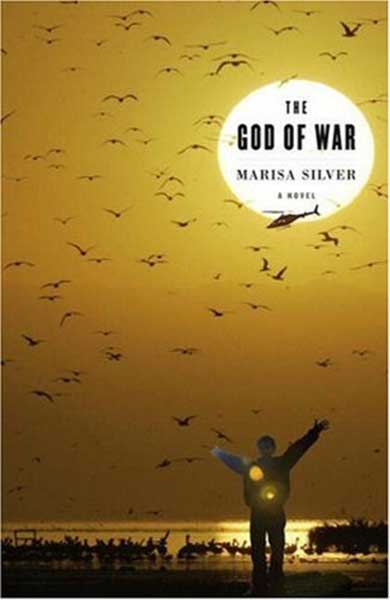
The God of War is the latest novel from Marisa Silver, author of No Direction Home and the story collection Babe in Paradise. Silver's fluid writing and vibrant descriptions merge to tell the moving story of two brothers; a story of loyalty, love, survival, and guilt, and how each of these things bind us. Twelve year-old Ares feels responsible for his mentally handicapped younger brother, Malcolm. Left to his own devices by their single mother, he attempts taking his first steps toward adulthood but finds himself irrevocably tethered to his family. Something in his past, a searing guilt that won't relent, keeps Ares forever looking out for his brother. The story, set in 1978 at the edge of the Salton Sea near California's Mojave Desert, encompasses the beauty and harshness of its rugged setting as it races to its inevitable conclusion.
1. How did this story come about? What made you choose the remote setting of the Salton Sea?
I have long loved the California desert but had never been to the Salton Sea before I began reading about it. What drew me to pick up the first history of the area? Perhaps the romantic alliteration of the name (finding a subject for a novel is a bit like falling in love), or the oddity of a sea existing within the bounds of a desert. As I read, I discovered the fascinating history of the place. I was taken with the notion that, a century ago, men had wrestled nature in order to reroute an entire river with the aim of making the arid land fertile. I loved the hubris of it and admired the pioneer audacity of these new Californians. The story of their efforts and the resulting floods was so dramatic that, for a while, I considered writing a historical novel. But when I began spending time at the Salton Sea, I was pierced by the forlorn beauty of the place, and I knew there was a contemporary story to tell—a story about the history of land and its legacy, and about a family. The historical themes of regeneration and of man's attempt to control unruly nature exist in this modern story, but now they are themes particular to the family I created, not simply the place. The sea and its surrounds are beautiful and desolate, lonely and brave—a combination that, to me, is something like life.
2. In fiction, there is the literary principle of 'Chekhov's Gun,' the law proposed by the Russian master of the short story that suggests that if there is a gun in the first act, it must go off by the third act. Did you have this in mind when you first conceived the story?
I always knew there was something buried in this story, but it took me a while to come around to the idea that this hidden thing was a gun. Many things were buried in this sea during various drafts of the novel, all of them leading the characters onto different paths. It was only when Kevin entered the picture and I understood why he was there that I knew that what was hiding was a gun. The gun is an object that represents both Kevin's violence and, in a strange way, Ares's fleeting innocence. He is fascinated with war and with guns, and weaves them into his fantasy games with his brother. But as the story progresses and he loses his innocence and becomes embroiled with Kevin, the actual potential of violence changes for him, and the gun becomes an inevitable actor in the story.
3. You came from the film world, having directed films like Old Enough and He Said, She Said. How was it adapting to the more solitary life of a fiction writer? How are the two worlds similar? Which do you find more creatively rewarding?
On a superficial level, of course, the worlds of filmmaking and fiction writing could not be more different. Standing on a set with upward of one hundred people who are all contributing to the final outcome, is about as diametrically opposite an experience from sitting alone in my room with my computer and my books as it gets. Personally, I'll take my room and my computer every time. I love the solitude (maybe to an unhealthy degree) and find that writing gives me the opportunity to slowly and carefully excavate character and story in a way that is hugely satisfying to me. Issues of craft in the two forms, however, overlap quite a bit. Filmmakers and writers are each telling stories with tools, and although a writer has no camera, she does have point of view, narrative distance, and movement at her disposal. At every moment of writing a scene, I am thinking about who I am seeing, where I am in the room, where characters are in relation to one another, what is happening in the background that may inform the scene and the emotions of it. The editorial choices in filmmaking are not dissimilar to those in writing—when to move to a new scene, what scenes to juxtapose to one another—all these choices serve to move the story in various ways. And when I am in a scene, I am, in fact, really acting through my characters, trying to feel what they would feel, say what they would say. Although I have never acted before, I imagine that the process I go through in creating characters and in trying to make them feel real and specific is not all that different from what an actor goes through.
4. Your literary career really took off after you were featured in the inaugural debut fiction issue of The New Yorker in 2001. How did you come to the attention of the magazine's editors? Do you have a preference between writing novels or stories?
My agent sent my work to The New Yorker when they were putting together the first debut fiction issue. Having my fiction debut in The New Yorker was a tremendous experience. I grew up with The New Yorker, and to see my story printed in that idiosyncratic font for the first time was quite a thrill. The magazine has a legacy that has meant a lot to me and that I was so proud to be part of. It was also great to have my work in a magazine that the committed readers of fiction turn to when looking for work from both new and veteran writers.
Writing short stories and writing novels are two enormously different jobs. The requirements of each might seem the same, except for the length, but, to me, they are quite different. A short story requires an economy of character and event. It requires that you illuminate a whole world in miniature. The challenge is compression. A novel, of course, is more expansive, but it has the added challenges that controlling a story over time and place involves. I love writing both, but both are equally hard for me. Although it was difficult at first, I have grown to appreciate the length of time it takes to write a novel. I like seeing how, year by year, the process develops, how the story shapes and reshapes, how characters deepen and define themselves over time. Writing novels has taught me patience.
5. In Greek mythology, the name Ares is used for thegod of war. At what point in your writing process did you decide to incorporate aspects of mythology? Why is Ares the “god of war” in this story?
Ares was always named Ares from the first moment I conceived of him. It was a name that Laurel would have given him—something iconoclastic, something a bit out of the norm. Although I knew that the name had mythological connotations, the meaning of his name vis-à-vis my particular story didn't come through to me until well into the process, when I recognized the personal war that this young boy was engaged in. Ares is at war with his family and with himself. He is fighting to break away from his mother as any adolescent does. In his particular case, the fight is harder because of the demands of Malcolm and his acute sense of responsibility for the way his brother is. And it is harder, too, because of the isolation he feels due to the place where he lives, the way his mother has cut the family off from those around them, and because of the fact of his brother. I think the process of self-definition we all go through during adolescence and even beyond can be seen as something of a battle between what is expected of us and what our burgeoning desire pushes us toward. The elements of actual war—the not too distant battles of Vietnam, and the proving ground that exists near where Ares lives—folded into the story not so much to satisfy the name, but as a surprising and happy coincidence.
6. What is your writing regime like? Do you outline first or just go where the story takes you? Who are some authors that have played an important role in your life? What one book could you not live without?
I wish I could outline a story. I wish I knew where I was going. I have no idea. I start with a situation, with some sketches of characters, and then, like a painter, perhaps, I fill in and fill in, deepening the lines and the colors until something feels real and until action and drama tell a story that moves me, that I care about telling. It is a herky-jerky process: a character does one thing, and then the story heads in a certain direction. But maybe that's wrong. So the character does something else, and I head down that new path. I recently learned how to throw a pot on a potter's wheel. As I watched the clay rise and fall and rise again, puff out here, slim down there, become something ungainly and then right itself, I thought: this is just like writing, only dirtier.
I read a lot. Old stuff. New stuff. William Trevor and Alice Munroe always. Madame Bovary, William Maxwell…the list is vast and there is no central theme. Sometimes I read simply to see how an author handles an aspect of craft: first person voice, flashback…Sometimes I read to let my conscious mind wander around in a world of another's words while my unconscious mind stews over my own work without my having to think about it. I keep note cards by me at all times. I wake up at night and write down things that I think are the solution to problems I've run into only to wake in the morning and find out that they solve nothing.
7. Was it challenging to write from the point of view of a twelve-year-old boy? How attached do you get to your characters? How much of yourself (if any) do you put into your characters?
It is always challenging to write from any point of view not my own because it requires inhabiting someone totally different from me and understanding them specifically enough so that how they move and speak and act is of a piece, so that these elements create a fictional character who is palpable. Characters need not be consistent, but they have to be inconsistently themselves. A twelve-year-old boy, which I am not, is as challenging as a mother, which I am, because I am not any mother, I am me, and the mother I write is not any mother, she is particular and peculiar to herself. Lately, I've been surrounded by a lot of adolescent boys, so I've been able to watch how they move and speak and gesture. I watch how they manage being trapped in that moment between childhood and adulthood—it is a potent, achingly lovely time.
8. The imagery and the detailed descriptions in the novel are so evocative and beautiful. Was the strong animal imagery intentional from the beginning or did it come about organically during the writing process?
One of the pleasures of writing is to make a scene sensory—to invest it with touch and smell and sound. One of the challenges is not to overburden a reader with so much information that it all becomes a meaningless wash. So the job is about picking and choosing details that not only describe a place, or a face, or an emotional moment, but also illuminate character, or cause the reader to make an association that expands his or her understanding of the scene, of life. When I hit the target, I know it, and then I clear away all the other stuff around it so that the detail makes the most amount of emotional and visceral impact.
9. You write about characters that sometimes make poor decisions and sometimes do awful things, yet it never seems like you are judging them. How do you keep your own feelings out of the equation?
There is no person who makes good decisions all the time, but most people make poor decisions with all the best intentions. Their mistakes might come from reading a situation wrong, or from the emotional scarring that they bring to their experience of life. We are none of us experts in the one job we have, which is to live and to love. I find this predicament of existence humbling and poignant.
10. The relationship between Ares and Malcolm is so palpable and resilient. Was their relationship based on a relationship you've experienced in your own life?
Although I am one of a troika of sisters, the relationship between brothers, starting with Jacob and Esau and Cain and Abel, has always moved me in a particular way. I don't know why this is. I've dedicated my book, in part, to my father and uncle. My father's stories of his life with his brother are full of humor and heartache. I have been captivated by these tales since childhood. I guess I still am.